 Scorify.uz
IELTS in 30 Days: A Daily Study Plan for Writing and Speaking
“The IELTS exam is a month away. Where do I even start?” Thousands of candidates ask this every day. The good news: 30 days with a well-built plan can be enough to improve your Writing and Speaking scores noticeably. The bad news: you cannot learn English from zero in that time.
Below is an honest, practical 30-day plan: what to do each week, how much time to set aside each day, and which mistakes to avoid. The plan focuses on Writing and Speaking, because these are the two parts where the right kind of practice changes your result fastest.
What is possible in 30 days, and what is not?
First, set a realistic goal. In one month you can:
- understand the test format, the timing and the marking criteria well;
- master a clear structure for Writing Task 2 and use it with confidence;
- reduce pausing and nerves in Speaking and give better-organised answers;
- find your most frequent mistakes and cut them down.
What a month cannot guarantee: learning English from scratch or changing your level completely. If your current level is far below your target, 30 days is only the beginning of the road. Even then, the plan below points you in the right direction.
Before you start: find your level
The plan begins with a diagnostic on day one. Write one Task 2 essay in 40 minutes and record one Speaking Part 2 answer (2 minutes). Then assess both against the criteria. Practising without knowing which criterion is your weakest is a waste of time.
For a quick assessment, you can check your essay and your recording for free on Scorify: it shows your band score, a score for each criterion and corrections. To work out your overall average, use the IELTS band calculator.
The 30-day plan: four weeks, four goals
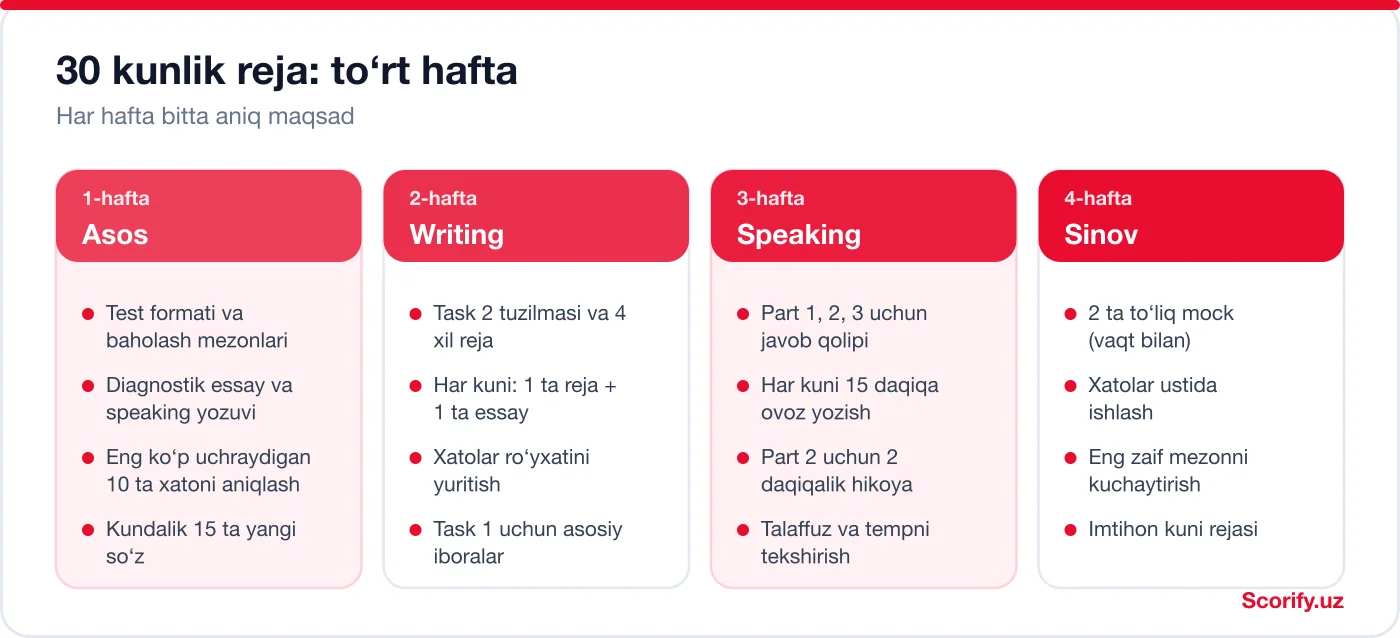
Week 1: Foundation (days 1–7)
Goal: know exactly what you are preparing for.
- Day 1: the diagnostic essay and recorded answer (described above).
- Days 2–3: learn the test format: Writing takes 60 minutes (Task 1 – 150 words, Task 2 – 250 words), Speaking takes 11–14 minutes and has three parts. Write out the four marking criteria.
- Days 4–5: list the 10 most repeated mistakes from your diagnostic (articles, verb tenses, plurals, linking words...).
- Days 6–7: learn 15 new topic words and phrases a day, inside sentences, not as single words.
Week 2: Writing (days 8–14)
Goal: a reliable structure for Task 2.
- Learn the Task 2 structure: plan, introduction, two main paragraphs, conclusion. For a detailed guide, see how to write IELTS Writing Task 2.
- Every day, write only a plan for one question (10 minutes): your position, two ideas and an example for each.
- Three times a week, write a full essay (40 minutes) and keep an error log.
- Choose questions from the Task 2 question bank and compare a model essay with your own.
Week 3: Speaking (days 15–21)
Goal: speak freely and in an organised way.
- Part 1: every day pick one topic (home, work, hobbies) and answer 6–8 questions with 2–3 sentences each. Ready-made questions: Speaking Part 1 topics.
- Part 2: every day choose one cue card, prepare for 1 minute and speak for 2 minutes. Samples: Speaking Part 2 cue cards.
- Part 3: answer general questions on your Part 2 topic, giving a reason and an example.
- Record yourself for 15 minutes each day and listen back: note pauses, repetition and unclear pronunciation.
Week 4: Practice tests (days 22–30)
Goal: get used to working under exam conditions and strengthen your weak spot.
- At least 2 full practice sessions a week: Task 2 in 40 minutes, then a full Speaking test in 12–14 minutes.
- After each session, identify your weakest criterion and focus on it for the next 2 days.
- Rewrite an earlier essay: same question, improved version.
- In the last 2 days, do not learn anything new. Just review your error log.
Daily schedule: 90 minutes is enough
Many candidates try to study 4–5 hours a day and burn out within a week. A far better approach is a short schedule you can keep every day: 90 minutes.
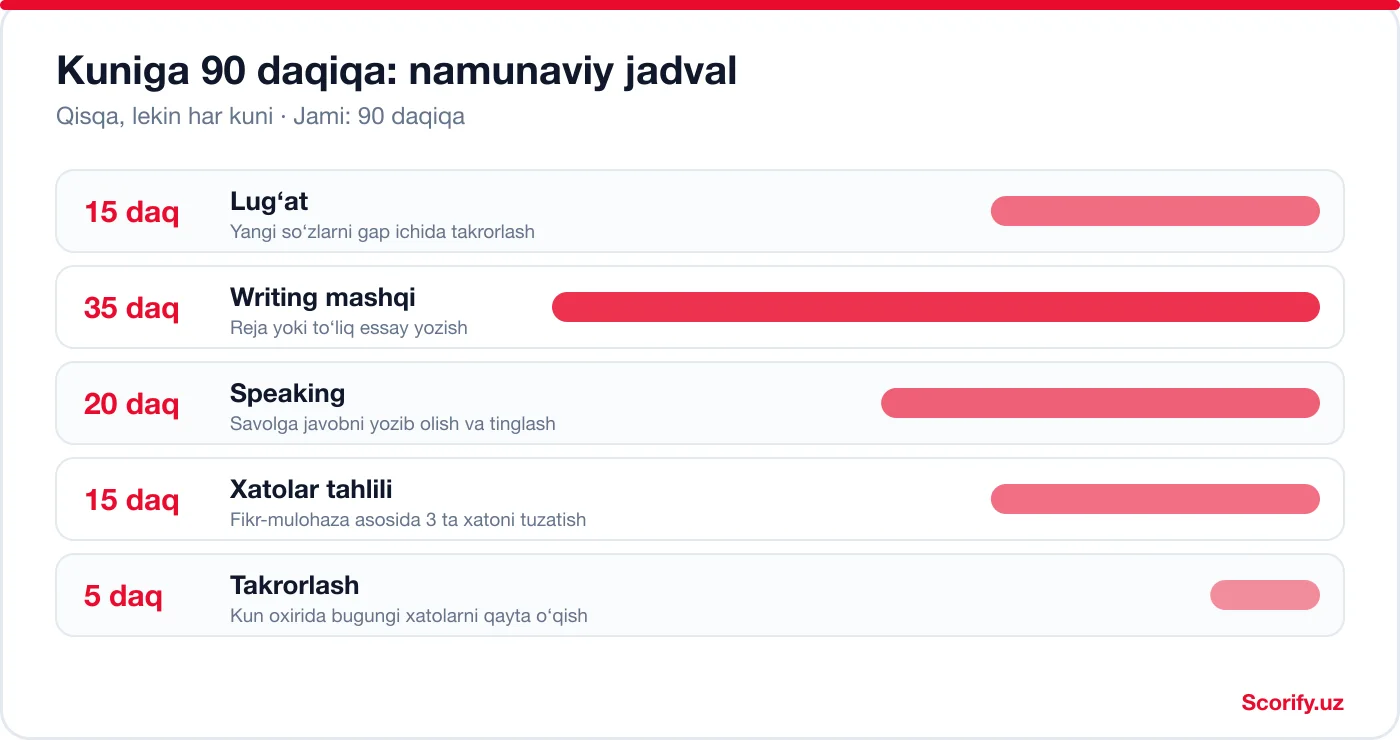
What matters is the split. Most time (35 minutes) goes to Writing, because that is where many candidates have the biggest score gap. The 15 minutes of error review are the main source of progress in the following days.
The error log: your strongest tool
Most candidates repeat the same mistakes every time. Open a simple notebook and, after each essay, write down the three most important mistakes with the correct version:
| My mistake | Correct version | Rule |
|---|---|---|
| People is concerned. | People are concerned. | Plural subject – plural verb |
| I went to the school by foot. | I went to school on foot. | Some expressions take no article |
| The crime rate have increased. | The crime rate has increased. | Singular subject – singular verb |
After a week, reread the log. The mistakes that keep coming back are your personal “error map”; fixing them is the shortest route to a higher score.
6 common preparation mistakes
- Only answering new questions. Essays written without feedback just reinforce the same mistakes.
- Practising without a timer. An essay written with unlimited time does not reflect exam conditions.
- Memorised templates. Memorised sentences that do not fit the topic lower your score.
- Leaving Speaking until last. Speaking skill does not develop quickly, so it should start no later than week 3.
- Studying 5 hours a day. Less, but regular, practice gives better results.
- Not knowing your weak spot. A score for each criterion shows you exactly what to practise.
The day before the exam
- Do not learn new topics or new words; just look through your error log.
- Review two Task 2 planning templates and the “start – develop – finish” pattern for Speaking Part 2.
- Check your documents, the time and the location, and go to bed early.
An answer pattern for Speaking
In Speaking, many candidates struggle not because they fall silent but because their ideas are disorganised. Use a simple pattern for every answer:
- Part 1 (2–3 sentences): a direct answer + a reason + a short example. “I enjoy cooking because it helps me relax. For example, I usually prepare dinner for my family on weekends.”
- Part 2 (2 minutes): an opening (“I’d like to talk about...”) → cover the four points on the card in order → a closing (“Overall, this experience...”).
- Part 3 (3–4 sentences): opinion + reason + example + the opposite view. “I think so, because... For instance... However, some people might argue that...”
You should not memorise the pattern. Repeat it on different topics until it feels natural. For full Part 2 examples, see Speaking Part 2 sample answers.
How should you memorise vocabulary?
15 new words a day is enough if you learn them inside sentences and reuse them in the following days. This method works well: put each new collocation (for example, raise awareness, a growing concern) into one sentence about your own life, use it in a Writing or Speaking exercise, and review it the next day. A word you never use is quickly forgotten.
Frequently asked questions
Can I prepare for IELTS in 30 days?
Yes, if your current level is close to your target and you follow the plan consistently. If your level is far below your target, 30 days will be a start, but you may need more time for a full result.
How many hours a day should I study?
For most candidates, 90 minutes of regular practice a day is more effective than 4–5 hours of disorganised study. What matters is working every day and with feedback.
Which should I start with: Writing or Speaking?
Take the diagnostic first, then give more time to your weaker part. In general, learning the Writing structure takes longer, so it makes sense to start it in weeks 1–2, and to build up Speaking in week 3.
Can I prepare without a teacher?
You can, but feedback is very important: it is hard to spot your own mistakes. An experienced teacher or a scoring tool (such as Scorify) quickly shows your weak criterion.
What should I watch out for on exam day?
Control your time: give Task 2 40 minutes and leave time for planning and checking. In Speaking, if you do not understand a question, you can calmly ask for it to be repeated; that is better than staying silent.
Start today
For the plan to work, take the first step today: write one Task 2 essay and record one Part 2 answer. Check them for free on Scorify to find your weak criterion, then move on to the 30-day plan. To go deeper into Writing, return to the Task 2 guide, and if you want to raise your score from 6 to 7, read 10 practical tips.
Scorify.uz provides independent practice and an estimated score. The official score is given only in the real IELTS exam.