 Scorify.uz
IELTS Writing Task 2 Essay Structure: The Band 7+ Template (With Example)
Most Task 2 essays do not lose marks because the writer lacks ideas. They lose marks because the ideas arrive in the wrong order, in the wrong paragraph, or without enough development. Fix the structure and a Band 6 essay often moves toward Band 7 without learning a single new word.
This guide gives you a clear, repeatable structure for IELTS Writing Task 2: what each paragraph does, how long to spend on it, which plan fits which question type, and a complete annotated example. You can use it for every essay you write from today.
Why structure matters so much in Task 2
Task 2 carries twice the weight of Task 1 in your Writing score, and you have 40 minutes for at least 250 words. Examiners mark four criteria equally: Task Response, Coherence and Cohesion, Lexical Resource, and Grammatical Range and Accuracy. A good structure directly improves the first two, and it frees up your attention to improve the other two.
Structure is not about memorising a template and pasting your topic into it. Examiners are trained to notice memorised, off-topic text. What you need is a flexible skeleton: a fixed job for each paragraph, with ideas that change every time.
The four-paragraph skeleton at a glance
For nearly every Task 2 question, four paragraphs are enough: an introduction, two body paragraphs and a conclusion. Here is how to spend your 40 minutes.
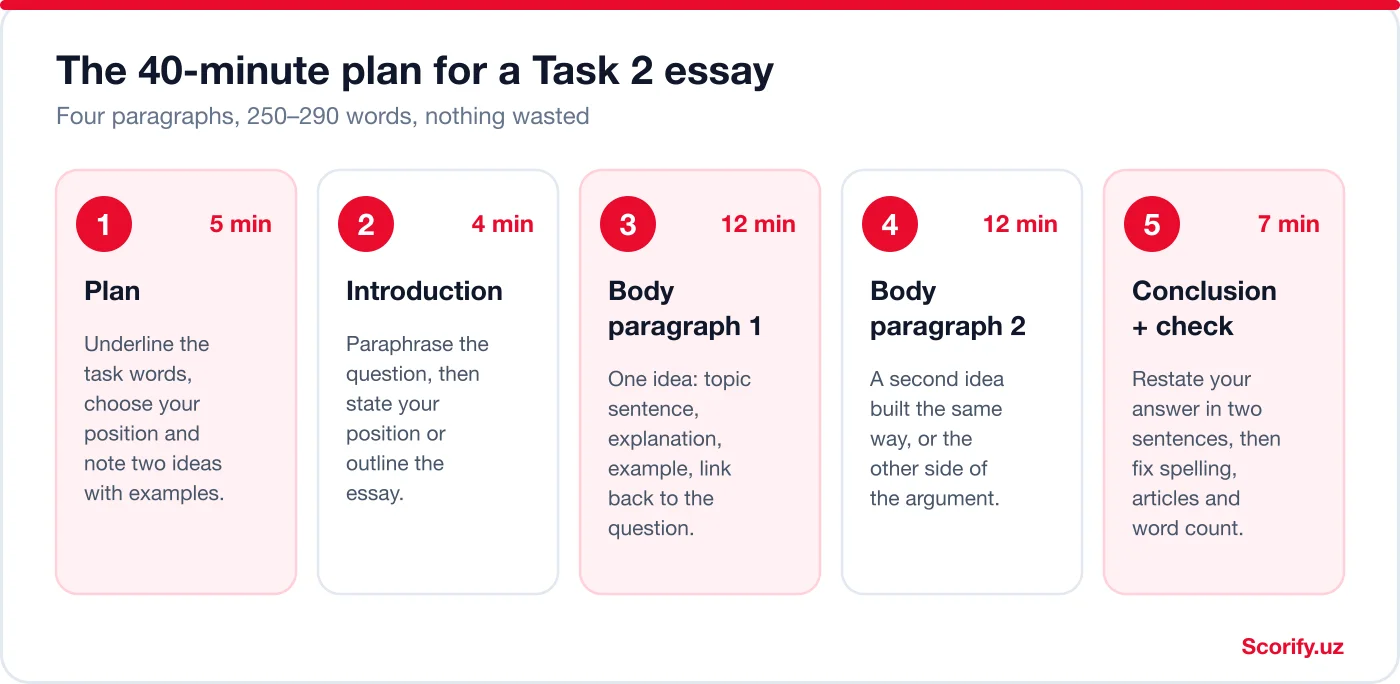
Notice that planning and checking take 12 of your 40 minutes. Candidates who start writing immediately usually run out of ideas halfway through the second paragraph, and candidates who skip the check leave easy mistakes on the page.
Paragraph 1: the introduction (two sentences)
A strong introduction does two jobs and nothing more:
- Paraphrase the question so the examiner can see you understood it.
- Give your answer: your position for an opinion question, or a short outline for a discussion question.
Do not write a long general opening such as "Since the beginning of time, humans have…". It wastes time and adds nothing to your score.
Question: Some people believe that cities should ban private cars from their centres. To what extent do you agree or disagree?
Introduction: Restricting private vehicles in urban centres is an increasingly popular policy, and I largely agree with it. Although there are practical difficulties, the benefits for public health and city life are greater.
See how the first sentence paraphrases ("ban private cars from their centres" becomes "restricting private vehicles in urban centres") and the second sentence states a clear position with a reason for it.
Paragraphs 2 and 3: body paragraphs that develop one idea each
Each body paragraph should contain one main idea and develop it fully. A reliable pattern is PEEL:
- P – Point: a topic sentence that states the idea.
- E – Explain: why or how this is true.
- E – Example: a specific, realistic example.
- L – Link: connect back to the question or your position.
Here is one paragraph written with PEEL:
The strongest argument for a ban is the improvement in air quality. (Point) Exhaust fumes from heavy traffic are a major source of the small particles that cause breathing problems, so removing cars from crowded areas protects residents and pedestrians. (Explain) Cities that have created car-free zones, such as Oslo, have reported cleaner air on those streets. (Example) Therefore, a ban can deliver a direct and immediate benefit to public health. (Link)
An example does not have to be a statistic. A realistic situation, a well-known city, or a common experience is enough, as long as it is specific. "In many countries" is not specific; "In Oslo" or "Many office workers who spend two hours commuting" is.
Choose the right plan for the question type
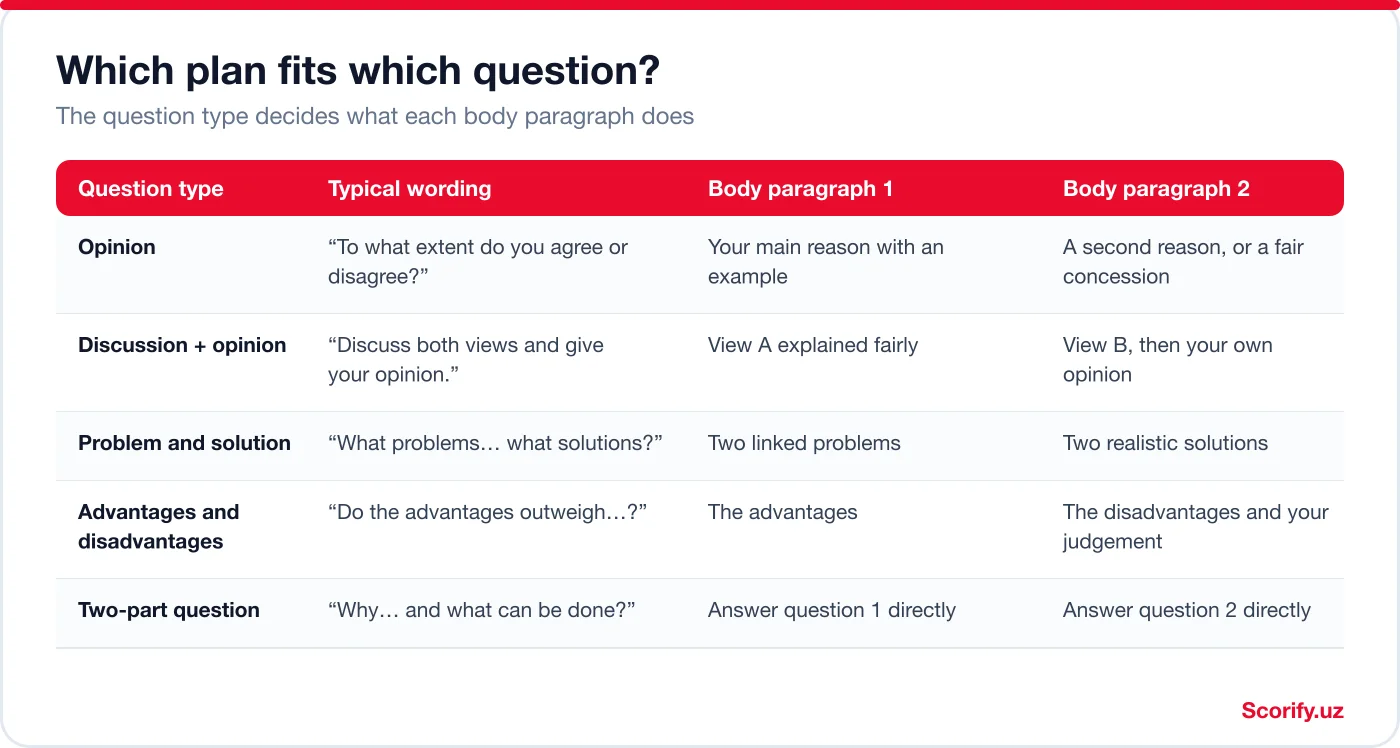
The wording of the question decides what each body paragraph should do. If you plan the wrong shape, you can write good English and still lose marks for Task Response.
Opinion questions
"To what extent do you agree or disagree?" asks for your position. Decide before you write whether you fully agree, fully disagree, or partly agree, and keep that position consistent in the introduction, body and conclusion. A partly-agree position is fine, but you must say which part you agree with.
Discussion questions
"Discuss both views and give your opinion" has three parts: view A, view B and your opinion. Give each view its own fair paragraph, and make your opinion clear in the introduction and the conclusion. Examiners often see essays that describe both views but never state a personal opinion, which limits the score.
Problem and solution questions
Write about two problems in the first body paragraph, then two solutions in the second. Make sure the solutions answer the problems you described; random solutions look disconnected.
Advantages and disadvantages questions
If the question asks whether the advantages outweigh the disadvantages, you must give a judgement. Cover both sides, then say which side is stronger in your introduction and conclusion.
Two-part questions
Answer each question in its own paragraph, directly. If the question asks "Why is this happening and what can be done?", paragraph two explains the causes and paragraph three offers solutions.
Want to see all of these plans applied to real questions? Browse our Task 2 questions with outlines and full sample essays.
Paragraph 4: the conclusion (two sentences)
Your conclusion should restate your answer and summarise your two main points. It should not introduce a new idea, and it should not repeat the introduction word for word.
In conclusion, I believe that limiting private cars in city centres improves air quality and makes streets safer and more pleasant, provided that public transport is available to replace them.
A complete example, with annotations
Below is a full essay for the car-ban question. Read it once for the ideas, and again to see how the structure works.
Introduction. Restricting private vehicles in urban centres is an increasingly popular policy, and I largely agree with it. Although there are practical difficulties, the benefits for public health and city life are greater.
Body 1: air quality and safety. The strongest argument for a ban is the improvement in air quality. Exhaust fumes from heavy traffic are a major source of the small particles that cause breathing problems, so removing cars from crowded areas protects residents and pedestrians. Cities that have created car-free zones, such as Oslo, have reported cleaner air on those streets. In addition, fewer vehicles mean fewer accidents, which makes streets safer for children and older people. Therefore, a ban can deliver a direct and immediate benefit to public health.
Body 2: city life and the economy. A second advantage is that people tend to enjoy city centres more when cars are absent. Wide pavements, outdoor cafés and street markets can replace parking spaces, and visitors stay longer and spend more. Admittedly, some shop owners fear losing customers who arrive by car. However, cities such as Copenhagen show that when walking and cycling are made easy, shops can thrive rather than suffer.
Conclusion. In conclusion, I believe that limiting private cars in city centres improves air quality and makes streets safer and more pleasant, provided that reliable public transport is available to replace them.
This essay is about 250 words, takes a clear position, develops two ideas with explanation and example, and even includes a short concession ("Admittedly…") that answers the most obvious objection.
Five structure mistakes that cost marks
- A very long introduction. If your introduction is longer than a body paragraph, shorten it.
- Two ideas in one paragraph. Examiners cannot tell which idea you are developing. Split them or choose the stronger one.
- Ideas without examples. "Pollution is bad for health" is a claim, not a developed idea.
- No clear position. Even in a discussion essay, tell the examiner which view you find more convincing.
- A conclusion that adds new ideas. The conclusion closes the essay; it does not open a new topic.
Your pre-submit checklist
- Have I answered every part of the question?
- Is my position clear in the introduction and the conclusion?
- Does each body paragraph have one idea, an explanation and an example?
- Is the essay at least 250 words?
- Have I checked articles (a/an/the), plurals and verb agreement?
Linking inside paragraphs without sounding memorised
Coherence and Cohesion is not about how many connectors you can fit in. It is about whether the reader can follow your logic. Inside a body paragraph, each sentence should have a clear relationship to the one before it: it adds a reason, gives an example, shows a result or admits a limit.
- Add a reason: "…because…", "…since…"
- Give an example: "For instance,…", "In Oslo,…"
- Show a result: "…so…", "As a result,…"
- Admit a limit: "Admittedly,…", "However,…"
Choose the connector that matches the relationship, and vary it. If every sentence starts with a connector, the writing sounds mechanical; if none do, the logic is hard to follow. A good test is to read each sentence and ask: why does this sentence follow the previous one?
What if I have three body paragraphs?
Some questions suit five paragraphs: an introduction, three body paragraphs and a conclusion. This works well for two-part questions where one part needs extra development, or when you want to include a separate concession paragraph. The rule does not change: one main idea per paragraph, each developed with explanation and example, and the essay still finishes in 40 minutes. If you are short on time, four paragraphs are always safer than five rushed ones.
Frequently asked questions
How many paragraphs should an IELTS Task 2 essay have?
Four paragraphs are enough for most questions: an introduction, two body paragraphs and a conclusion. Five paragraphs, with three body paragraphs, can work if you have time and a third idea to develop properly.
How many words should a Task 2 essay be?
You must write at least 250 words. Most strong essays are between 260 and 290 words. There is no benefit in writing much more, because extra length usually brings extra errors and weaker focus.
Can I use a template for Task 2?
You can use a structural skeleton, such as the four-paragraph plan in this guide. You should not memorise full sentences and insert your topic. Examiners are trained to recognise memorised material, and it can reduce your Task Response and Lexical Resource scores.
Is it acceptable to use "I" in a Task 2 essay?
Yes. In opinion questions, phrases such as "I believe" or "In my view" are natural and expected. Use them sparingly and support every opinion with a reason.
How long should the introduction be?
Two sentences are enough: one that paraphrases the question and one that states your position or outlines your answer. A longer introduction takes time from the body paragraphs, where most marks are earned.
Practise the structure, then measure it
Structure improves fastest with feedback on your own writing. Choose a question from our Task 2 question bank, write under timed conditions, and check the result against the four criteria. If you want an instant band estimate with corrections, try Scorify free: submit your essay and see exactly which paragraph lost marks and why. To understand how those marks are decided, read our guide to how IELTS band scores are calculated.