 Scorify.uz
How to Improve IELTS Writing from Band 6 to Band 7: 10 Fixes That Work
Band 6 in IELTS Writing is the most common place to get stuck. You write clear English, you answer the question, and your teachers say the essay is "fine", yet the score does not move. If you need Band 7 for university admission, a visa or a job, this plateau can feel like a wall.
It is not a wall. The difference between a Band 6 and a Band 7 essay is usually a small set of specific habits, and every one of them can be trained. This article gives you ten fixes, in order of impact, with before-and-after examples so you can see exactly what changes.
What actually separates Band 6 from Band 7
Examiners mark four criteria equally: Task Response, Coherence and Cohesion, Lexical Resource, and Grammatical Range and Accuracy. At Band 6 a candidate is competent in all four but not consistent in any. At Band 7 the same candidate is clear, developed and mostly accurate.
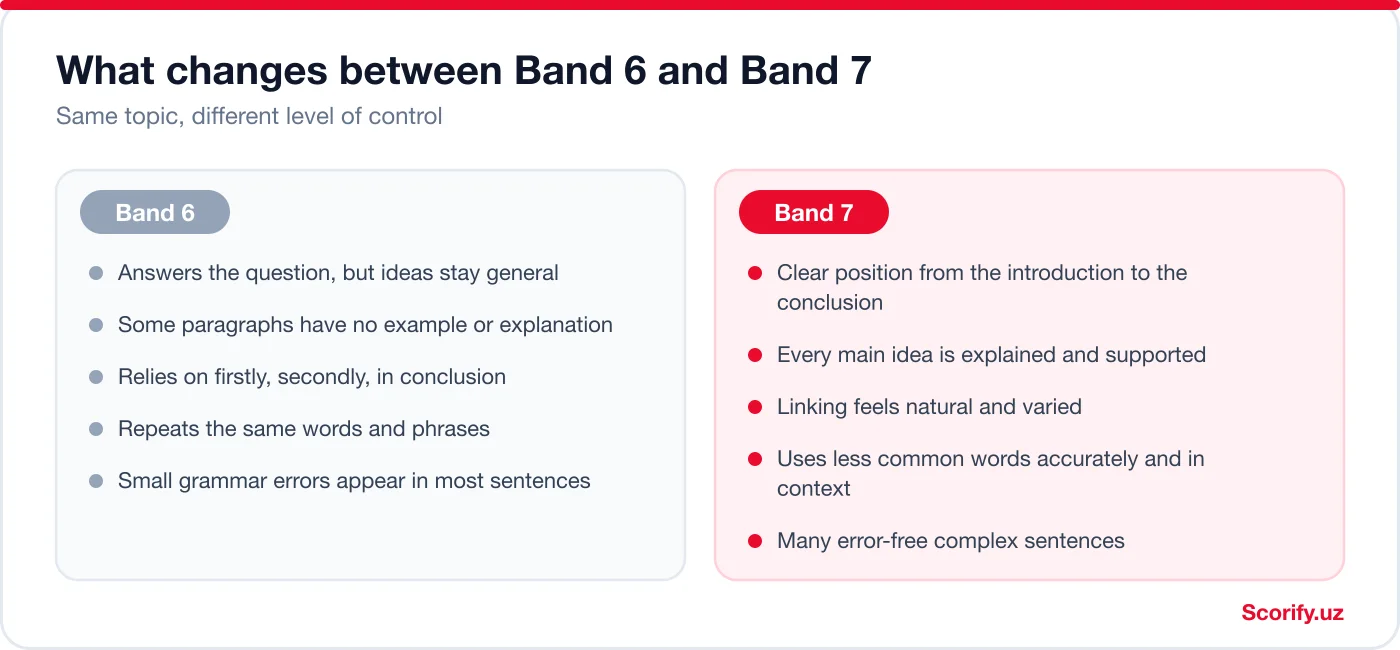
You do not need to become a different writer. You need to become a more controlled one. Here is how.
Fix 1: Answer every part of the question
Many Band 6 essays are well written but only half answer the question. If the question says "Discuss both views and give your opinion", you need three things: view one, view two and your opinion. If it says "What problems does this cause and what solutions can be proposed?", you need problems and solutions.
Do this: before you plan, underline the instruction words and count the parts. Write the number of parts at the top of your plan and tick each off as you write it.
Fix 2: State a clear position and keep it
A Band 7 essay has a visible position from the introduction to the conclusion. A Band 6 essay often changes its mind halfway, or hides its opinion in the last line.
Before (Band 6): "There are advantages and disadvantages of online learning, and it depends on the person."
After (Band 7): "Although online learning has real advantages, I believe it cannot completely replace classroom teaching."
Fix 3: Develop each idea with an explanation and an example
This is the single biggest difference between the bands. Band 6 paragraphs often state an idea and move on. Band 7 paragraphs explain why it is true and give a specific example.
Before: "Social media is bad for teenagers because it causes problems."
After: "Social media can harm teenagers because constant comparison with edited images lowers their self-esteem. For instance, a teenager who sees classmates' holiday photos every day may feel that their own life is dull, and this can lead to anxiety."
The second version tells the examiner what the problem is, how it happens and what it looks like in real life.
Fix 4: Use one main idea per paragraph
When two ideas share one paragraph, neither is developed properly, and the reader loses the thread. Give each main idea its own paragraph, and open it with a topic sentence that says what the paragraph is about. If you cannot summarise a paragraph in one sentence, it probably contains too much.
Fix 5: Link ideas by logic, not by memorised phrases
Candidates at Band 6 often rely on a fixed list: Firstly… Secondly… Moreover… In conclusion…. Used mechanically, these words can actually reduce your Coherence and Cohesion score.
Before: "Firstly, cars cause pollution. Secondly, cars cause accidents. Thirdly, cars cause noise."
After: "Cars cause pollution, which damages residents' health. They are also a leading cause of accidents, so streets without them are safer for children."
The second version shows the relationship between ideas ("which damages", "so") instead of just listing them. Use linking words to show cause, contrast and consequence, not to decorate.
Fix 6: Replace repetition with precise vocabulary
You do not need rare words for Band 7. You need precise, natural words. Instead of repeating "bad" and "big", name the thing exactly.
- "big problem" becomes "serious problem" or "growing concern"
- "bad for health" becomes "harmful to public health"
- "a lot of people" becomes "a large proportion of the population"
- "get a job" becomes "find employment"
Learn words in collocations (natural word partners) rather than singly: "raise awareness", "tackle a problem", "a growing trend". Then paraphrase the question instead of copying its words.
Fix 7: Control complex sentences
Band 7 needs a good proportion of error-free complex sentences. This does not mean long, complicated sentences. It means accurate use of structures such as conditionals, relative clauses and contrast.
Before: "Many people use public transport. It reduces pollution."
After: "If more people used public transport, pollution would fall considerably."
Accuracy matters more than ambition. A simple, correct sentence is worth more than a complicated, broken one. Use complex structures where they feel natural, and check each one.
Fix 8: Keep an error log and fix your top three mistakes
Most candidates repeat the same few mistakes in every essay: missing articles, subject-verb agreement, singular and plural forms, or comma splices. Instead of trying to fix everything, keep a short error log, find your top three recurring mistakes and make fixing them your only grammar goal for a week.
A small number of corrected habits can change a Grammatical Range and Accuracy score faster than studying new grammar.
Fix 9: Practise under time, with a plan
If you only write essays at home with unlimited time, the exam will feel different. Practise Task 2 in 40 minutes, including five minutes of planning and a few minutes of checking. A short plan with two ideas and an example for each is the best protection against running out of ideas and against writing off-topic.
Fix 10: Rewrite, don't just write more
Writing a new essay every day feels productive, but it often repeats the same mistakes. The fastest improvement comes from a loop: write, get feedback, fix the biggest problems, and rewrite the same essay.
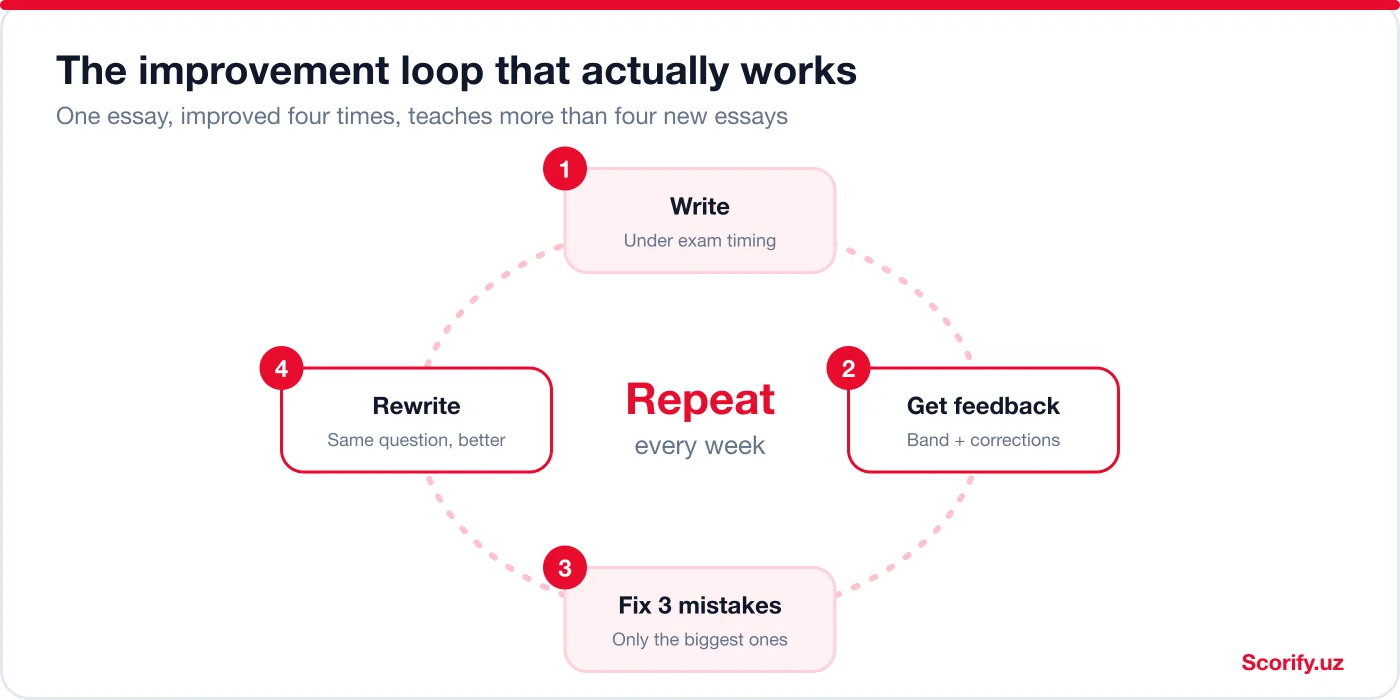
When you rewrite, you practise the improved version of your own ideas, and the correction sticks. One essay improved four times usually teaches more than four new essays written with the same habits.
How long does the jump from 6 to 7 take?
There is no honest universal answer. It depends on your current level of English, how much you practise, and how good your feedback is. What is true is that improvement comes from focused practice on your specific weaknesses, not from the number of essays you write. Candidates who identify their weakest criterion and train it deliberately move faster than those who write more of the same.
One paragraph, upgraded from Band 6 to Band 7
Here is how the fixes above work together in a single body paragraph. The topic is whether remote work benefits employees.
Band 6 version:
Working from home is good because people save time. Also, they can work more flexible. Many people like this. Another reason is that it saves money for them.
The ideas are relevant, but they are general, unexplained and linked with simple connectors. There is no example, and several expressions are unnatural ("work more flexible").
Band 7 version:
The main advantage of working from home is the time and money it saves on commuting. A worker in a large city may spend two hours travelling each day, and removing this journey gives them more time for family, exercise or rest. Moreover, they no longer need to pay for fuel or public transport, which is a significant saving over a year. As a result, employees often feel less stressed and more satisfied with their jobs.
Notice what changed: one clear main idea, a topic sentence, an explanation of why it matters, a realistic example, a result, and linking that shows logic. The vocabulary is more precise ("commuting", "significant saving"), yet the words themselves are not rare. This is the pattern to aim for in every body paragraph.
Frequently asked questions
Why am I stuck at Band 6 in IELTS Writing?
The most common reasons are ideas that are not fully developed, limited vocabulary range, repeated grammar errors and mechanical linking. Often one or two criteria hold the score down, so finding your weakest criterion is the fastest way forward.
Do I need advanced vocabulary for Band 7?
No. You need precise, natural vocabulary used accurately. A few well-chosen collocations are worth more than many rare words used incorrectly.
Is it better to write long, complex sentences?
Not necessarily. Band 7 needs a good proportion of error-free complex sentences, but a mix with simple sentences is normal. Accuracy matters more than length or complexity.
How often should I practise Writing?
Regular, focused practice works better than occasional long sessions. Many candidates make good progress with three to four timed essays a week, if each one is followed by feedback, corrections and a rewrite.
Should I memorise sample essays?
Reading sample essays is useful for seeing structure and ideas, but memorising them is risky. Examiners can recognise memorised text, and it rarely fits the exact question. Learn the patterns, then write your own sentences.
Your next step
The key to all ten fixes is knowing which ones you need. That requires feedback on your own writing: a band estimate, a score for each criterion and clear corrections. Scorify gives you exactly that for free on your first essay. Write one timed Task 2 essay, see where it loses marks, and apply the loop above.
If you want the structure behind a Band 7 essay, read our guide to the Task 2 essay structure, and to understand how examiners score each criterion, see IELTS band scores explained. You can also practise with real questions in our Task 2 question bank.