 Scorify.uz
How to Pass IELTS Speaking: A Complete Guide to Parts 1, 2 and 3
IELTS Speaking is the most intimidating part for many candidates. Talking face to face with an examiner, working against the clock and not knowing in advance which questions you will get all add to the nerves. In fact, the Speaking test has a clear structure, and it is the same every time: three parts, a short time limit and understandable criteria. Once you understand the structure, much of the anxiety fades.
In this guide you will learn step by step how the Speaking test works, what to do in each part, how it is marked and which kinds of practice work best.
How does the Speaking test work?
The Speaking test lasts 11–14 minutes, is held one-to-one with an examiner and is recorded. It has three parts.
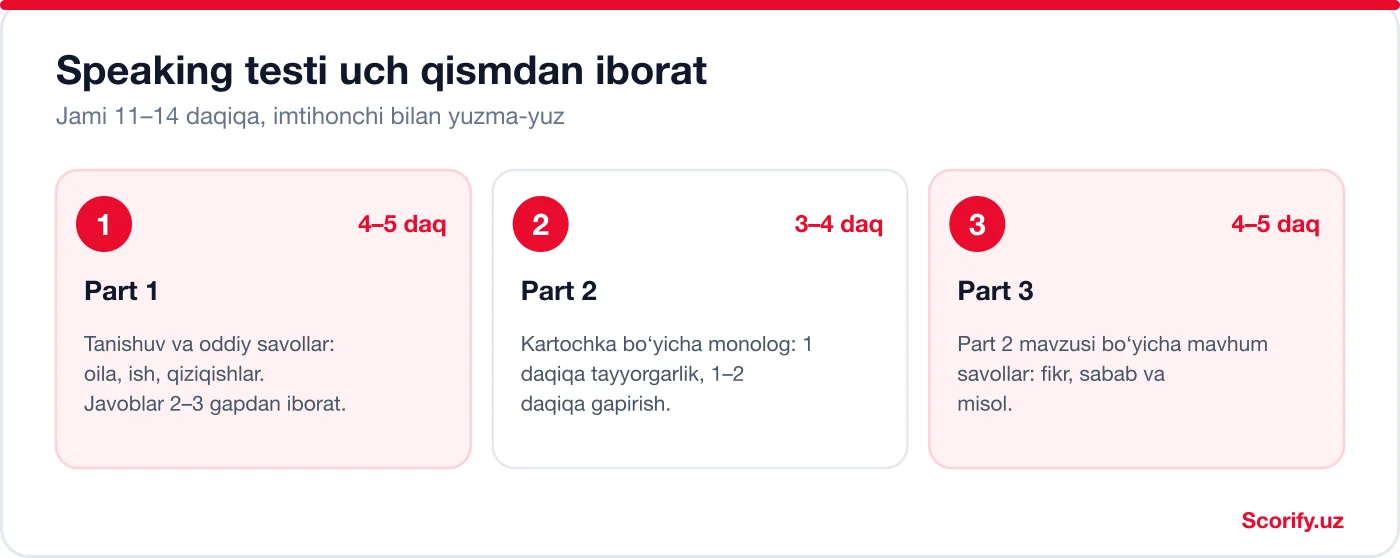
Part 1: introduction and simple questions (4–5 minutes)
The examiner first asks your name and confirms your identity, then asks questions on familiar topics such as home, work or studies, and hobbies. No long speeches are needed in this part.
- How to answer: a direct answer + a reason + a short example. Two or three sentences are usually enough.
- Example: “Do you like cooking?” — “Yes, I do. It helps me relax after a busy day. For example, I usually cook dinner for my family on weekends.”
- Mistake: a one-word answer (“Yes.”) or a very long, prepared speech.
You will find ready-made questions on different topics and sample answers in the Speaking Part 1 topics section.
Part 2: a monologue from a cue card (3–4 minutes)
The examiner gives you a card with a topic, for example “Describe a place you visited”. The card has four prompts. You have 1 minute to prepare, then you speak without stopping for 1–2 minutes.
- Preparation: write key words, not full sentences (one for each prompt).
- Structure: an opening (what you will talk about), developing each prompt (details, feelings, an example), and a closing (a conclusion).
- Timing: try to speak for the full 2 minutes. Stopping early can lower your fluency score.
Full samples for Part 2: Speaking Part 2 cue cards. For a detailed strategy, also read our Part 2 guide.
Part 3: discussion (4–5 minutes)
In Part 3 the examiner asks questions linked to your Part 2 topic but much more abstract: “Why do people love travelling?”, “How has technology changed communication?”. Here it is not only your experience that is tested, but also your opinions and your ability to analyse.
- Pattern: opinion + reason + example + (if needed) the opposite view.
- Useful phrases: “I think…”, “One reason is…”, “For instance…”, “On the other hand…”.
- Length: 3–5 sentences per answer.
Developed answers by topic: Speaking Part 3 questions.
How is Speaking marked?
The examiner marks you on four criteria. Each criterion makes up 25 percent of the overall score.
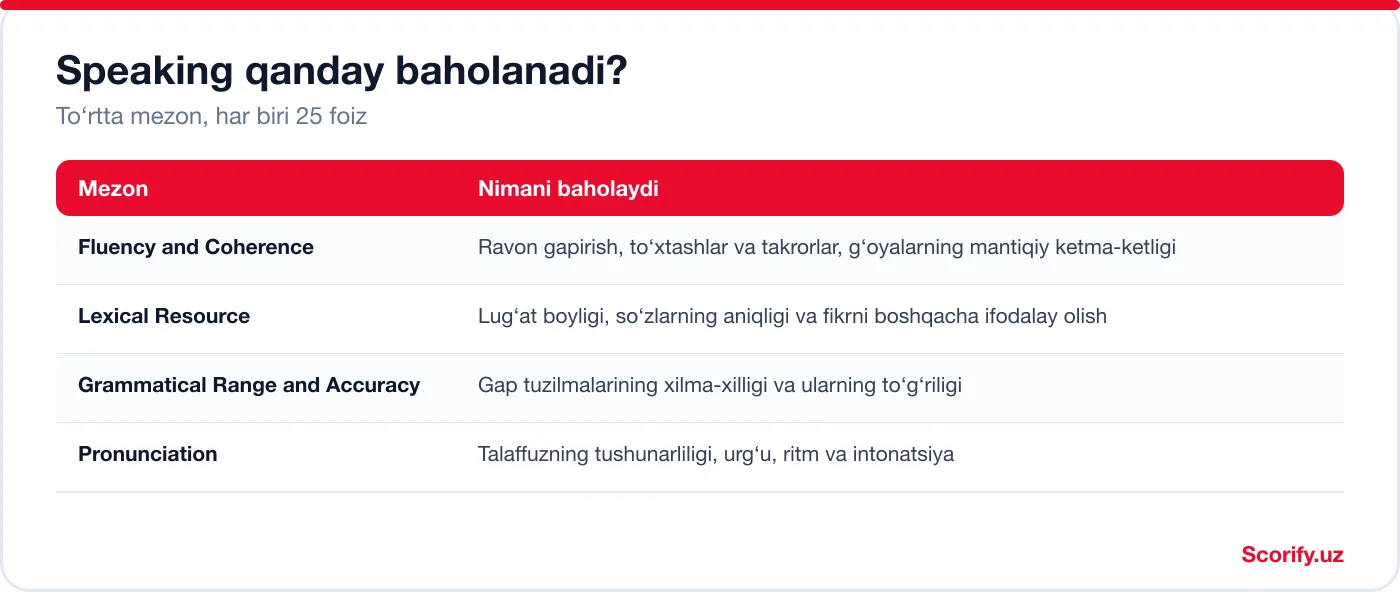
- Fluency and Coherence: do you speak smoothly and logically? Lots of pausing and repetition lowers this score.
- Lexical Resource: the range of your vocabulary and how accurately you choose words. If you forget a word, being able to say it another way (paraphrase) is also a good sign.
- Grammatical Range and Accuracy: a mix of simple and complex sentences, and how accurate they are.
- Pronunciation: your pronunciation must be easy to understand. A foreign accent is not a problem; being understood is what matters.
More about the criteria: how IELTS scores are calculated.
8 practical tips for Speaking
- Record your voice. You notice your mistakes when you listen back, not while you are speaking.
- Extend your answers. After “Yes/No”, add a reason and an example.
- Do not memorise. Examiners can recognise a memorised speech. Learn structures, not scripts.
- If you get stuck, use natural phrases: “Let me think…”, “Well, I suppose…”.
- Correct a mistake and carry on. If it is a small slip, do not stop.
- Learn collocations: ready-made combinations such as “make a decision” and “raise awareness” sound natural.
- Control your speed. Fluent does not mean fast.
- Practise 10–15 minutes every day. Regular practice beats long but rare sessions.
Try it right now: pick a Part 2 question, speak for 2 minutes and upload it to Scorify. The site shows you an estimated band score, a score for each criterion and a written transcript, so you can read your own mistakes.
Frequently asked questions
How long does the Speaking test last?
11–14 minutes in total: Part 1 takes about 4–5 minutes, Part 2 about 3–4 and Part 3 about 4–5.
What if I cannot speak for 2 minutes in Part 2?
Stopping early reduces the evidence the examiner has for fluency and vocabulary. Add feelings, details and examples to reach 2 minutes.
What should I do if I do not understand a question?
You can politely ask the examiner to repeat it: “Could you repeat that, please?”. That is better than guessing and giving a wrong answer.
Does my accent affect my score?
No. What is assessed is how clear your pronunciation is, not your accent. Pay attention to stress, rhythm and intonation.
Can I prepare for Speaking alone at home?
Yes, but feedback matters. Recording and listening to yourself, or using a scoring tool, quickly shows your weakest criterion.
If you want to build a study plan, read how to prepare for IELTS in 30 days.
Scorify.uz provides independent practice and an estimated score. The official score is given only in the real IELTS exam.