Scorify.uz
IELTS Speaking Part 2: How Many Minutes to Speak (With a Practice Timer)
Speaking Part 2 is the part of the IELTS test that candidates fear most. You receive a topic card, you have one minute to prepare, and then you must speak alone for up to two minutes while the examiner listens in silence. There is no question to guide you after the first sentence, and many candidates run out of ideas after forty seconds.
The good news is that Part 2 is the most predictable part of the test. The format never changes, the topics repeat in recognisable patterns, and a simple structure can carry you through two full minutes. This guide shows you that structure, step by step, with a complete model answer and the mistakes that cost the most marks.
How IELTS Speaking Part 2 works
The whole Speaking test lasts 11 to 14 minutes. Part 2 lasts about three to four minutes in total:
- The examiner gives you a card with a topic, such as “Describe a place you visited”, and four short prompts that start with “You should say…”.
- You have one minute to prepare. You receive a pencil and paper to make notes.
- You speak for one to two minutes. The examiner will stop you at two minutes.
- The examiner may ask one or two short follow-up questions before Part 3.
Speaking for the full two minutes matters. If you stop at one minute, you give the examiner little evidence for your fluency and vocabulary, and your score can suffer.
Part 2 practice timer
First a 1:00 preparation countdown, then a 2:00 speaking countdown. In the real test you may finish between 1:00 and 2:00; here the clock runs to 2:00 so you can practise filling the time. Nothing is recorded or sent anywhere.
Ready
1:00
The two-minute plan
Think of your answer as four blocks: prepare, open, develop and close. This skeleton works for every cue card, whatever the topic.
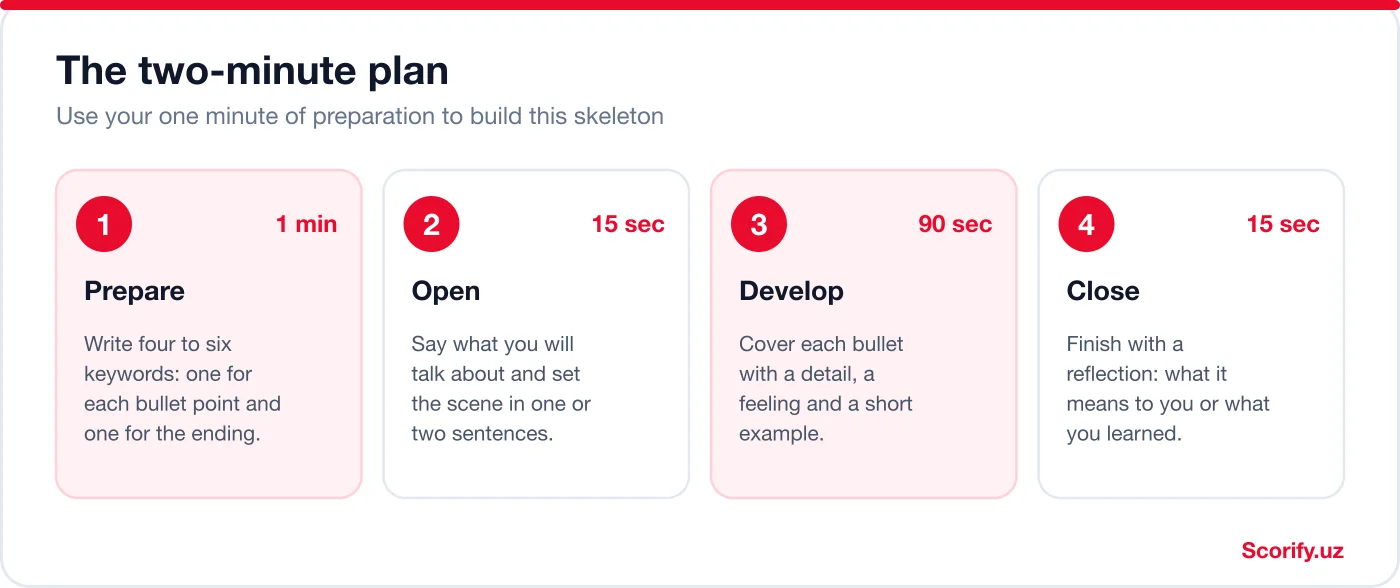
1. Prepare: use your minute for keywords, not sentences
Do not try to write full sentences. You will not have time, and reading from notes sounds unnatural. Instead, write four to six keywords: one for each prompt on the card and one for how you will end. For example, for “Describe a place you visited”: Bukhara – family – old city, tiles – tea, photos – proud.
2. Open: set the scene in one or two sentences
Begin with a clear statement of what you will talk about. Good openings include:
- “I’d like to talk about a place I visited last summer, which was Bukhara.”
- “The person I’d like to describe is my cousin, who has…”
- “Something I really enjoyed doing recently was…”
3. Develop: cover each prompt with detail, feeling and example
This is the longest block, about ninety seconds. For each prompt, do not give only a fact. Add a detail (what it looked like or what happened), a feeling (how you felt) and a short example or moment. A prompt such as “what you did there” becomes: “We walked through the old streets, and I remember sitting in a small tea house where an old man told us about the history of the city. It made me realise how much culture is hidden in ordinary places.”
4. Close: finish with a reflection
Do not stop suddenly. A short closing sentence tells the examiner you have finished and shows control: “Overall, it was an unforgettable trip, and I’d love to go back.”
Try it now: pick any cue card from our Speaking Part 2 collection, set a timer for two minutes and record yourself. You can also upload the recording to Scorify and receive an estimated band with feedback on fluency, vocabulary, grammar and pronunciation.
What to do when you run out of ideas
Almost everyone gets stuck at some point. Here are four techniques that keep you talking naturally:
- Add the past, present and future. “I used to…”, “Nowadays I…”, “In the future I’d like to…”.
- Describe senses. What did you see, hear, smell or taste?
- Explain why. “The reason I chose it was…”, “That mattered because…”.
- Compare. “Unlike other places I’ve visited…”, “It was much quieter than I expected.”
Use short thinking phrases if you need a moment, such as “Let me think…” or “What I remember most is…”. Natural pauses are fine; long silences are not.
A full model answer
Cue card: Describe a place you visited that you enjoyed. You should say where it was, when you went there, what you did there, and explain why you enjoyed it.
I’d like to talk about a trip to Bukhara that I took with my family two summers ago. It’s an ancient city in central Uzbekistan, about five hours from Tashkent by train, and it’s famous for its old mosques and covered bazaars.
We stayed for three days in a small guest house in the old town. During the day, we walked through narrow streets, visited several madrasas and tried local food, such as fresh bread and sweet pastries. One afternoon, we sat in a tea house by a pond, and an elderly man started telling us stories about the city’s history. We listened for almost an hour, and I remember how peaceful the atmosphere was.
I enjoyed the trip for several reasons. First, it was a chance to spend quality time with my family without any distractions. Second, the architecture was breathtaking, especially in the evening when the buildings were lit up. And finally, I learned a lot about my own heritage, which made me feel proud.
Overall, it was one of the best trips I’ve ever had, and I hope to go back one day.
This answer is about 210 words, which takes roughly 90 seconds to two minutes at a natural pace. Notice the structure: a clear opening, one paragraph for each pair of prompts, a personal moment with detail, a numbered list of reasons (first, second, finally) and a short close.
Band 6 versus Band 7 in Part 2
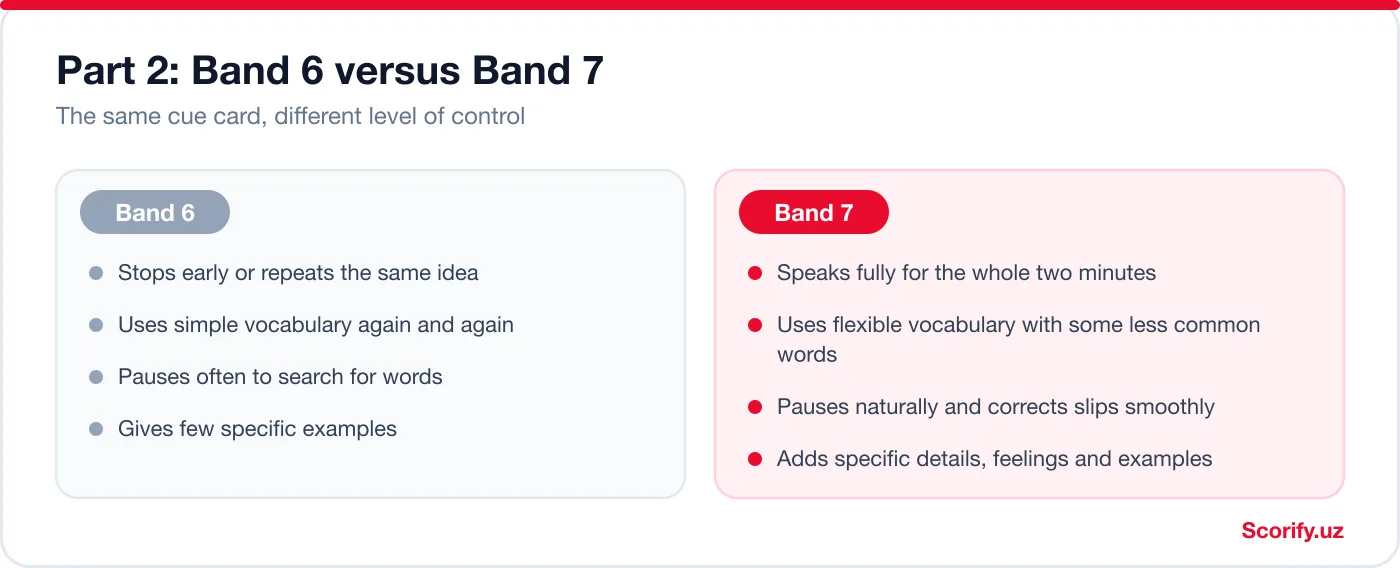
The difference is rarely about rare vocabulary. It is about control: speaking for the full time, giving specific details and handling small mistakes smoothly. If you say a word incorrectly, correct it quickly and continue; examiners value that more than perfect silence.
Five common Part 2 mistakes
- Stopping too early. Practise with a timer until two minutes feels natural.
- Memorising a speech. Examiners recognise it, and you cannot adapt it to the card. Learn the structure, not the words.
- Answering only the bullets. The bullets are a guide; add feelings and examples.
- Using only the present or past tense. Show a range of structures where they fit.
- Speaking too fast. Clear, steady speech is easier to understand and scores better for pronunciation.
A simple weekly practice routine
- Monday to Friday: take one cue card per day, make notes for one minute and speak for two minutes. Record yourself.
- Listen back: note pauses, repeated words and grammar mistakes. Fix two points only.
- Weekend: repeat your weakest answer and compare the two recordings.
To go deeper into each topic, read the sample answers in our Part 2 cue card library and the follow-up discussions in Speaking Part 3.
Frequently asked questions
How long should I speak in IELTS Speaking Part 2?
Aim for the full two minutes. The examiner will stop you at two minutes, and speaking for the whole time gives the best evidence of your fluency and vocabulary.
What if I do not know anything about the topic?
You can describe an imaginary example or change the details slightly. The examiner is testing your English, not your experiences, so a believable story told fluently is fine.
Can I write notes during the preparation minute?
Yes. You will be given paper and a pencil. Write keywords only, not sentences, and use them as prompts.
Do I have to cover all four bullet points?
It is strongly recommended. The bullets help you organise your answer, and covering them shows that you can follow the task.
How can I practise Part 2 alone?
Record yourself answering cue cards with a two-minute timer, then listen and note mistakes. A tool that gives instant feedback, such as Scorify, makes this faster because it shows your strongest and weakest criteria.
Start practising today
Part 2 improves quickly with regular, short practice. Choose a cue card, set your timer and speak. When you are ready for feedback, record your answer on Scorify and see exactly where you can gain a band. For a bigger picture of how the Speaking test is scored, read what examiners look for in Speaking Band 7.
Scorify.uz provides independent practice and estimated scores. Only an official IELTS test gives an official band score.
Sources
This is a simplified summary of public IELTS information. For the current rules, check the official sources: ielts.org (IELTS), IDP IELTS: band score calculation and British Council IELTS. Test centres have the final word on your test day.