Scorify.uz
IELTS Band Score Explained: How Writing and Speaking Are Marked
Few things confuse IELTS candidates more than the band score. How is the overall score calculated? Why does a 6.75 become a 7.0? What exactly does an examiner look for in Writing and Speaking? And what is the real difference between Band 6 and Band 7?
This guide explains it clearly. You will learn how the overall band is calculated, how Writing and Speaking are marked criterion by criterion, and what each band level actually looks like in practice, so you can set a realistic target and train for it.
How the overall band score is calculated
IELTS gives a band score from 0 to 9 for each of the four skills: Listening, Reading, Writing and Speaking. Your overall band score is the average of those four scores, rounded to the nearest half band. The rounding rule works like this:
| Average of four sections | Overall band | Rule |
|---|---|---|
| 6.125 | 6.0 | Rounds down to the nearest whole band |
| 6.25 | 6.5 | .25 rounds up to the next half band |
| 6.375 | 6.5 | Rounds to the nearest half band |
| 6.75 | 7.0 | .75 rounds up to the next whole band |
For example, if you score Listening 7.5, Reading 7.0, Writing 6.0 and Speaking 6.5, the average is 6.75 and your overall band is 7.0. You can test any combination with our free IELTS band score calculator.
One practical consequence: a single weak skill can pull your overall band down, and a strong skill can lift it. Writing is the skill where most candidates have the largest gap between what they need and what they currently score, which is why it deserves the most focused practice.
How IELTS Writing is marked
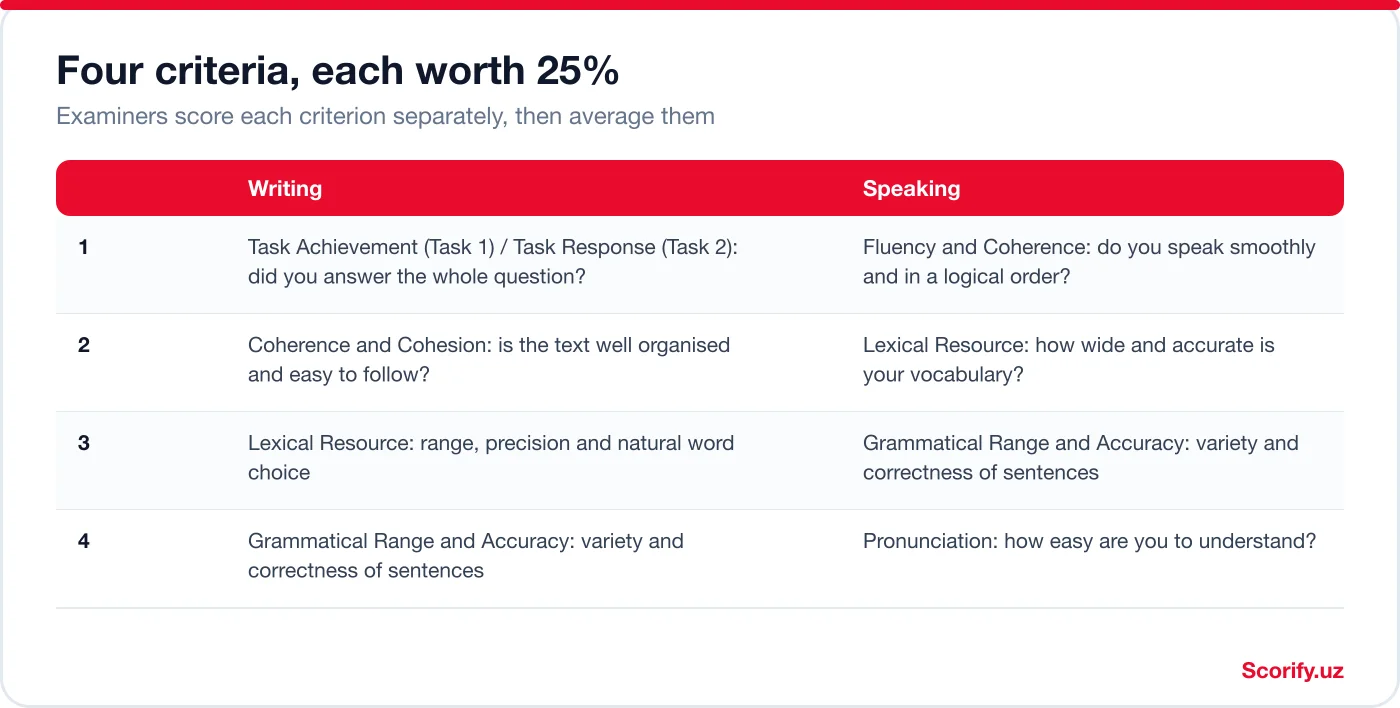
Writing has two tasks. Task 1 (150 words, about 20 minutes) and Task 2 (250 words, about 40 minutes). Task 2 counts for twice as much as Task 1 in your Writing score. Both are marked on four equally weighted criteria, each worth 25%.
1. Task Achievement / Task Response
This criterion asks whether you answered the question that was actually asked. In Task 1 you must report the key features of the data and give an overview. In Task 2 you must cover every part of the question, take a clear position, and develop your ideas. Writing fewer than the minimum number of words can reduce this score.
2. Coherence and Cohesion
Is your writing organised logically? Examiners look at paragraphing, clear progression of ideas and the natural use of linking words. Using many connectors is not the goal; using them accurately and only where they help the reader is.
3. Lexical Resource
This is your vocabulary: its range, precision and naturalness. Examiners reward the right word in the right context, including common collocations, and they notice when rare words are used incorrectly or when the same words are repeated too often.
4. Grammatical Range and Accuracy
Do you use a variety of sentence structures, and how often are they correct? Band 7 expects frequent error-free complex sentences. Band 6 usually shows an attempt at complex sentences with noticeable errors.
How IELTS Speaking is marked
The Speaking test lasts 11 to 14 minutes and has three parts: an introduction and interview, a long turn on a topic card, and a discussion. It is recorded and marked by a trained examiner on four criteria, again weighted equally.
- Fluency and Coherence: how smoothly you speak, how often you hesitate or repeat yourself, and whether your ideas are logically connected.
- Lexical Resource: the range and precision of your vocabulary, including your ability to paraphrase when you forget a word.
- Grammatical Range and Accuracy: your mix of simple and complex structures and how accurate they are.
- Pronunciation: how easy you are to understand, including word stress, rhythm and intonation. A native-like accent is not required.
To see how these criteria apply to real answers, read a few of our Speaking Part 2 sample answers and notice how the vocabulary, tense use and structure change from a basic answer to a strong one.
What each band level feels like
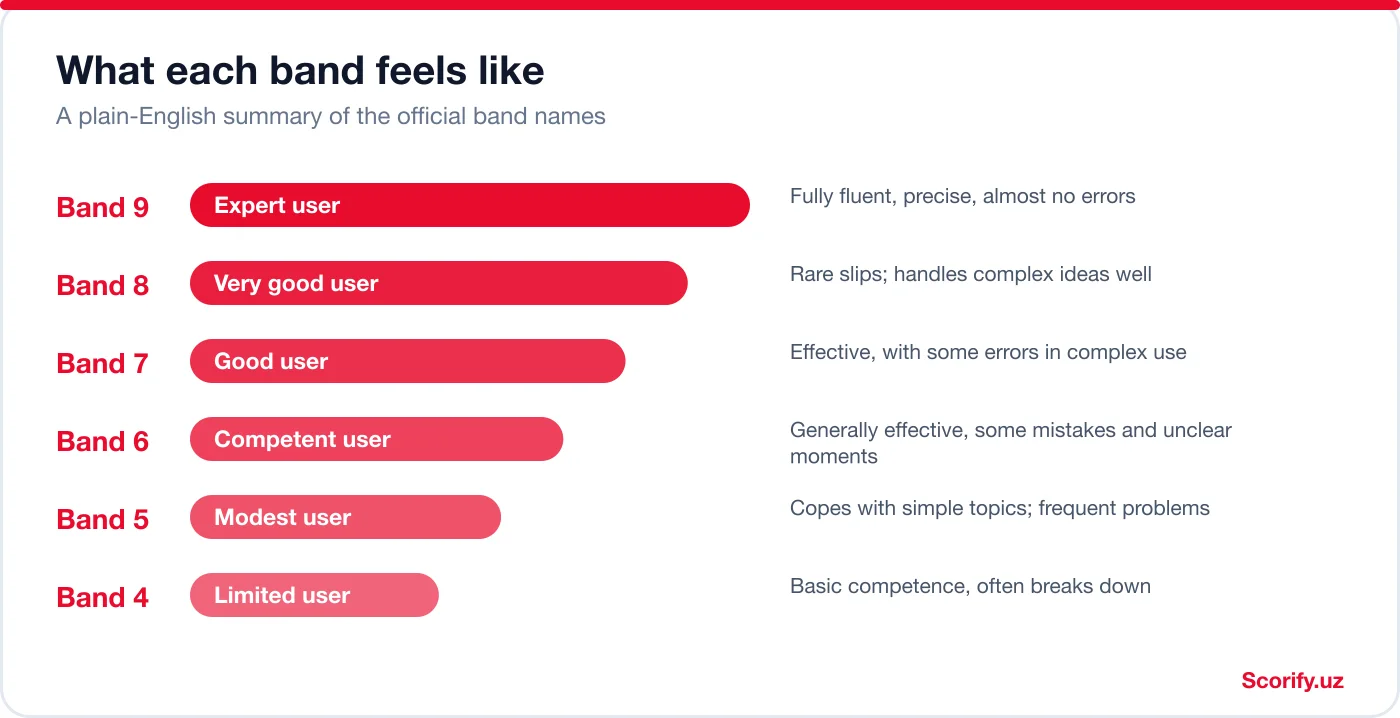
The official band descriptors are long and written for examiners. Here is a plain-English summary of the levels most candidates aim for.
Band 6: competent
You communicate effectively in most situations, though you make mistakes and sometimes lose clarity. In Writing, your ideas are relevant but not always fully developed; in Speaking, you can talk at length but with noticeable hesitation or repetition.
Band 7: good
You handle complex language well, and your mistakes are occasional rather than constant. In Writing, ideas are clearly developed and supported, and paragraphs flow naturally. In Speaking, you speak at length with little effort and use a range of vocabulary and grammar flexibly.
Band 8 and above
Mistakes become rare and unsystematic. Vocabulary is wide and precise, and ideas are handled with sophistication. Band 9 describes full command of the language, with only the slips a skilled native speaker might make.
Five common misunderstandings about band scores
- "Longer essays score higher." Length helps only if the content is relevant. Over-long essays often contain more errors and weaker focus.
- "Using rare words raises my Lexical Resource." Accuracy and naturalness matter more than rarity. A misused rare word can lower your score.
- "A memorised template guarantees a good Task Response." A skeleton is useful; memorised sentences that do not fit the question are penalised.
- "Speaking is about accent." Examiners score clarity, not an accent. Clear, comfortable speech wins.
- "Task 1 and Task 2 matter equally." Task 2 counts double, so it is the best place to invest your practice time.
Task 1 versus Task 2: where to spend your practice time
Because Task 2 contributes twice as much as Task 1 to your Writing score, an improvement in Task 2 raises your Writing band faster. That does not mean Task 1 can be ignored. It has its own demands: in the Academic test you must select and report the key features of a chart, table, map or process, and you must write a clear overview. In General Training you write a letter with the correct tone. Weak Task 1 answers, such as missing an overview or describing every number, are one of the most common reasons for a Writing score that is lower than expected.
A sensible split for most candidates is roughly two Task 2 essays for every Task 1 answer, adjusted to wherever your own scores are weakest.
Spelling, punctuation and word count
There is no separate mark for spelling or punctuation. However, they are part of the assessment. Frequent spelling errors affect Lexical Resource, and punctuation mistakes can reduce Grammatical Range and Accuracy and Coherence and Cohesion. Writing fewer than the required number of words (150 for Task 1, 250 for Task 2) can also lower your Task Achievement or Task Response score, so always check your length.
Frequently asked questions
What is a good IELTS band score?
It depends on your goal. Different universities, employers and visa programmes set their own requirements, and they may also ask for minimum scores in each skill, not just the overall band. Always check the exact requirement for your course or application before choosing a target.
Who marks IELTS Writing and Speaking?
Both are marked by trained and certified examiners using public band descriptors. Listening and Reading are marked against an answer key.
Do all four Writing criteria count equally?
Yes. Task Achievement or Task Response, Coherence and Cohesion, Lexical Resource and Grammatical Range and Accuracy each contribute equally to the score for a task.
Why is my overall band lower than my best skill?
The overall score is the average of all four skills, so a weaker skill pulls it down. A candidate with Listening 8.0, Reading 7.5, Writing 6.0 and Speaking 6.5 has an average of 7.0, even though two skills are higher.
How can I estimate my Writing and Speaking band before the exam?
Write a timed Task 2 essay and record a Part 2 answer, then compare each against the four criteria. A tool that scores each criterion separately makes it easier to see your weakest area. Remember that any practice score is an estimate, and only an official test gives an official result.
How to find your real band score today
Reading about band descriptors only goes so far. The most reliable way to learn your level is to write a timed Task 2 essay, record a Part 2 answer, and have each one assessed against the four criteria. Once you know which criterion is your weakest, you know exactly what to practise next.
That is what Scorify does: you submit an essay or a spoken answer and receive an estimated band, a score for each criterion and corrections you can act on immediately. Try it free, or start with a question from our Task 2 question bank. If you are aiming for a specific jump, our guide to improving Writing from Band 6 to Band 7 shows what to change first.
Scorify.uz provides independent practice and estimated scores. Only an official IELTS test gives an official band score.