Scorify.uz
IELTS Speaking Band 7: What Examiners Look For and 12 Tips
Band 7 in IELTS Speaking is a popular target for university admission and migration, and it is also a realistic one. It does not require a perfect accent, rare idioms or flawless grammar. It requires you to speak at length, with little effort, using a flexible range of language, with only occasional mistakes.
This guide explains how examiners award marks in the four Speaking criteria, shows what changes between Band 6 and Band 7, and gives you twelve practical tips that you can start using today. At the end, you will find a short practice cycle that works even if you have only ten minutes a day.
How the Speaking test is marked
The Speaking test lasts 11 to 14 minutes and is recorded. A trained examiner scores you on four criteria, and each criterion carries equal weight:
- Fluency and Coherence: how smoothly and logically you speak.
- Lexical Resource: the range and accuracy of your vocabulary.
- Grammatical Range and Accuracy: the variety and correctness of your sentence structures.
- Pronunciation: how easy you are to understand.
The four scores are averaged and rounded to a half band. Because the criteria are equal, a weakness in one area can be balanced by strength in another, but a very low score in one will hold your overall result down.
What changes between Band 6 and Band 7
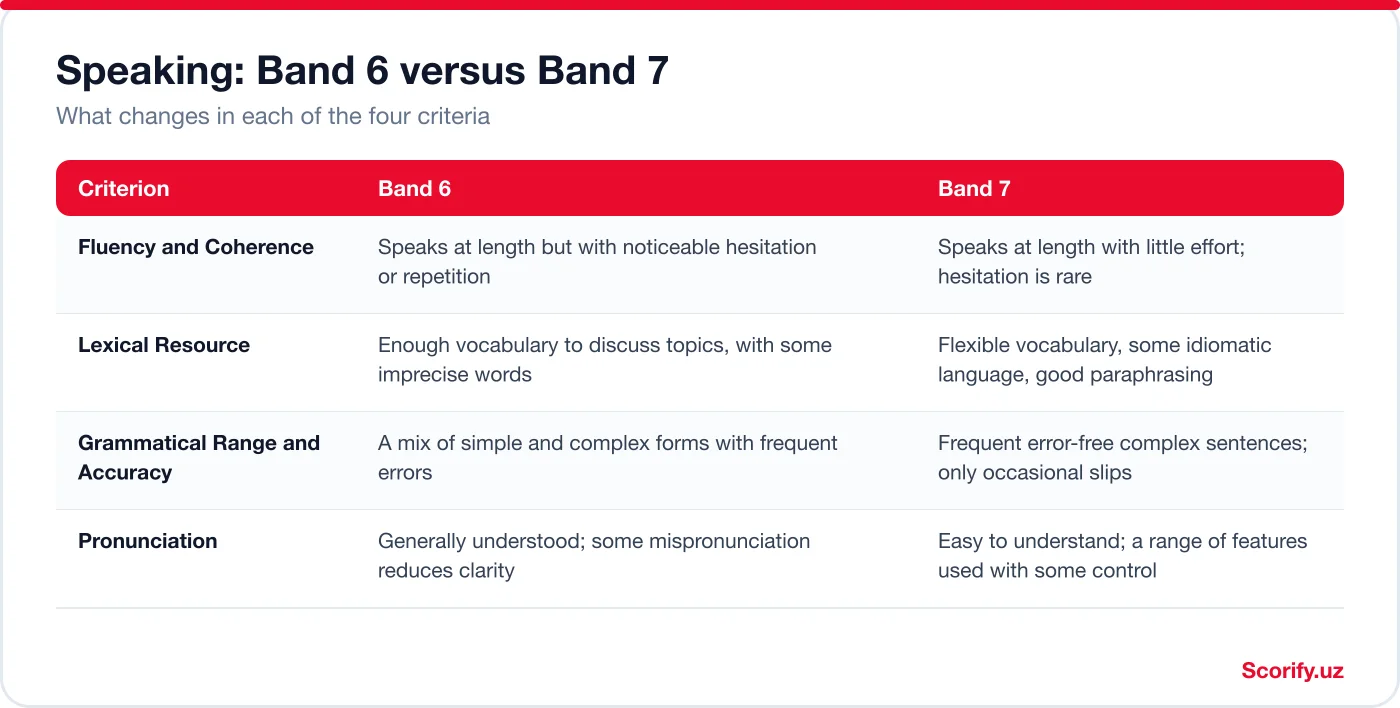
At Band 6 you can speak at length but you hesitate, repeat yourself or lose the thread sometimes. You use enough vocabulary to discuss topics, though some words are imprecise, and you attempt complex sentences but make frequent mistakes. At Band 7 your speech flows with little effort; you can paraphrase if you forget a word, you use some less common vocabulary naturally, and many of your complex sentences are correct.
Twelve tips for Speaking Band 7
Fluency and Coherence
- Answer, then extend. In Part 1, give a direct answer and add a reason or example: “I enjoy cooking because it helps me relax. For instance, I usually prepare dinner for my family on weekends.”
- Use natural fillers, not silence. Phrases like “Let me think…”, “Well, I suppose…” and “That’s an interesting question” give you a moment to organise your ideas.
- Connect ideas with logic. Words such as “because”, “so”, “although” and “which means” show relationships between ideas. Avoid using only “and”.
Lexical Resource
- Learn collocations, not single words. “Make a decision”, “raise awareness” and “a heavy workload” sound natural, while individual rare words often do not.
- Paraphrase when you forget a word. “The thing you use to cut paper” is better than silence, and examiners notice this skill positively.
- Use topic vocabulary precisely. Prepare ten to fifteen words for common topics such as education, technology, work and health. You can find lists in our IELTS vocabulary by topic section.
Grammatical Range and Accuracy
- Mix simple and complex sentences. Use conditionals (“If I had more time, I would…”), relative clauses (“a teacher who helped me a lot”) and contrast (“Although it was expensive, it was worth it”).
- Use a variety of tenses. Describe the past, present and future where it fits, especially in Part 2.
- Fix your top three errors. Record yourself and note repeated mistakes, such as missing “-s” or wrong prepositions. Concentrate on these for a week.
Pronunciation
- Stress the important words. English rhythm depends on stressed syllables. Speak clearly, not fast.
- Use intonation to show meaning. A flat voice is harder to follow and sounds less engaged.
- Finish your words. Pronounce the endings of words (-ed, -s, -t), because dropping them can change meaning.
Part 1, 2 and 3: how each part helps you score
- Part 1 (4–5 minutes): short answers about familiar topics. Show natural, relaxed English and add reasons. Practise with our Part 1 topic pages.
- Part 2 (3–4 minutes): a long turn. Show that you can organise ideas and speak for two minutes. See the guide to speaking for two minutes and the cue card library.
- Part 3 (4–5 minutes): abstract discussion. Show that you can give opinions, compare, speculate and explain. Study the model answers in Speaking Part 3.
A Band 6 and a Band 7 answer compared
Question: Do you enjoy reading?
Band 6 style:
Yes, I like reading. I read books sometimes. They are interesting. I like novels and also books about history. I read in my free time.
Band 7 style:
Yes, I do, actually. I try to read for about half an hour every evening because it helps me unwind. I mostly enjoy historical novels, since they make the past feel more real than a textbook, although I sometimes switch to non-fiction when I want to learn something new.
The second answer is not more difficult because of rare words. It is better because it gives a reason, uses connectors (because, since, although), includes a natural collocation (help me unwind) and sounds like a real person speaking.
The practice cycle that works
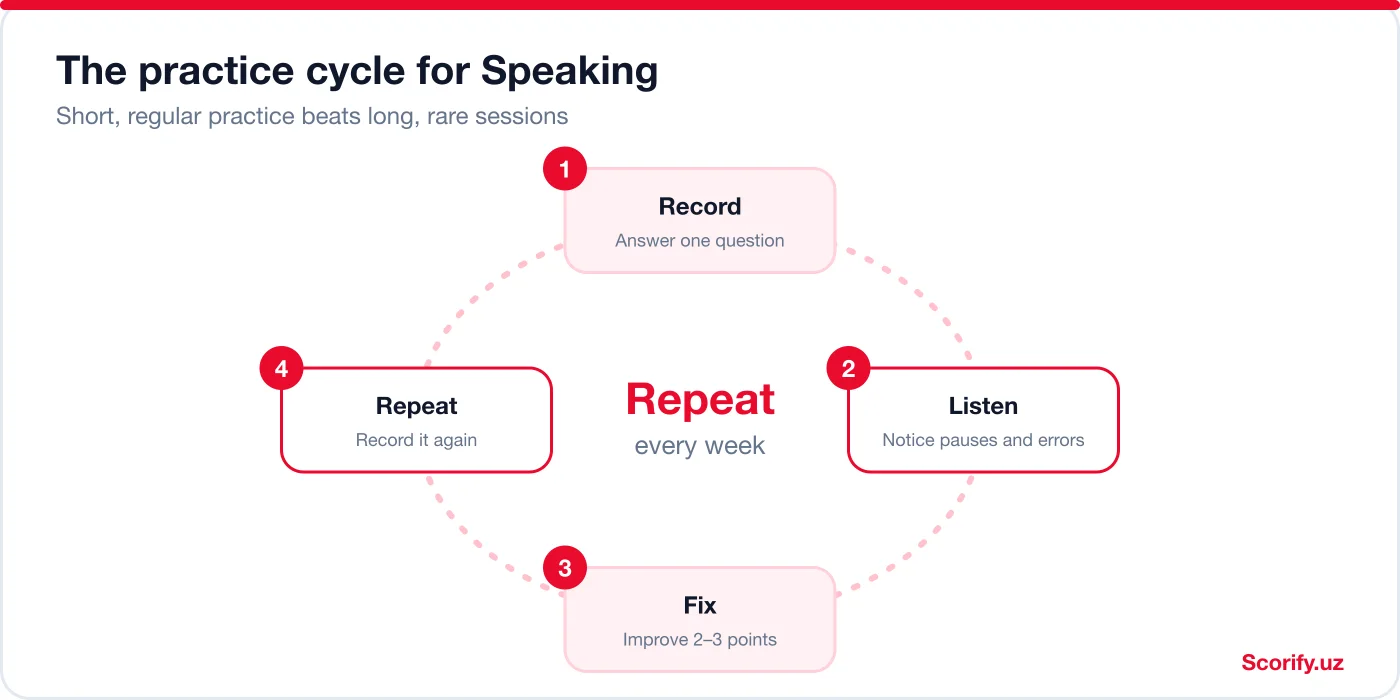
Short, regular practice beats long, occasional sessions. Choose one question, record your answer, listen to it critically, fix two or three points and record it again. Ten minutes a day is enough to see progress within a few weeks. The listening step is the most valuable one, because you will hear problems that you cannot notice while speaking.
Try it now: record a Part 2 answer on Scorify and see an estimated band with scores for fluency, vocabulary, grammar and pronunciation, plus a transcript so you can read your own mistakes.
Frequently asked questions
Do I need a native accent for Band 7?
No. Pronunciation is scored for clarity, not for a particular accent. You need to be easy to understand, with good use of stress, rhythm and intonation.
Can I use idioms in the Speaking test?
You can, but only if they are natural and accurate. A forced idiom can sound unnatural and may reduce your score. Common collocations are safer than rare expressions.
What if I do not understand a question?
You can ask the examiner to repeat or rephrase it politely: “Could you repeat that, please?” This is acceptable and better than guessing.
How long does it take to reach Band 7 in Speaking?
It depends on your starting level and how often you practise. Regular, focused practice with feedback usually produces progress faster than study without speaking.
Is it better to speak fast to sound fluent?
No. A natural, steady pace is better. Fluency means speaking smoothly and logically, not quickly, and rushing often increases mistakes.
To see how the Writing and Speaking criteria compare, and how the overall band is calculated, read IELTS band scores explained, and use our band score calculator to check your target.
Scorify.uz provides independent practice and estimated scores. Only an official IELTS test gives an official band score.